


Software Development Life Cycle: Why It Is Critical for Businesses
At CDT Software Support Private Limited, we help organizations build reliable and scalable digital solutions by following a structured software development life cycle. In today’s competitive environment, a disciplined development app
Moreover, understanding what is software development life cycle is essential for companies investing in technology across inventory management, logistics, warehouse systems, ecommerce, and automation-driven platforms.
What Is Software Development Life Cycle?
The software development life cycle is a structured framework used to plan, design, build, test, deploy, and maintain software systems. It defines clear stages and responsibilities to ensure that software meets business goals while remaining secure and scalable.
At CDT Software Support Private Limited, we treat the SDLC framework as a strategic roadmap that aligns technical execution with real operational requirements.
Why a Structured Development Lifecycle Is Essential for Businesses
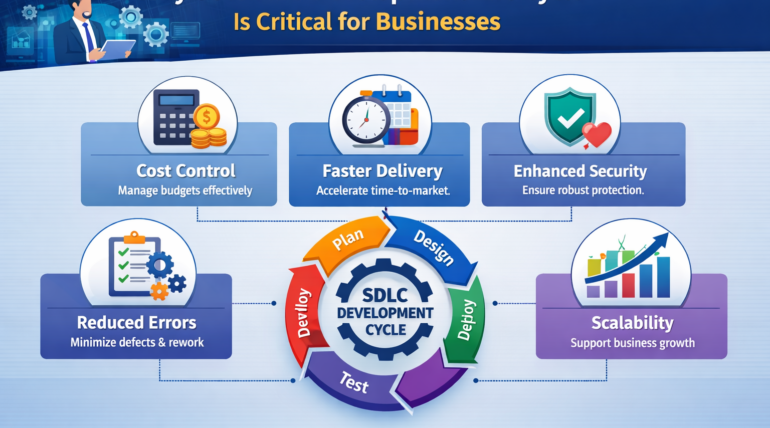
A structured development lifecycle brings consistency and predictability to software projects. Without a defined process, businesses often face delays, cost overruns, and quality issues. However, organizations that follow a disciplined SDLC framework experience improved outcomes.
For example, key business benefits include:
-
Better control over timelines and budgets
-
Reduced development risks
-
Improved collaboration between stakeholders
-
Higher system reliability
Consequently, this approach becomes especially critical for enterprise systems supporting logistics, ecommerce supply chains, and warehouse operations.
Phase 1: Requirement Analysis and Planning
The first step in the SDLC process is understanding business needs in detail. At this stage, we work closely with stakeholders to define what the software must achieve. In addition, we evaluate operational workflows to identify potential risks early.
As a result, requirement analysis ensures clarity before moving into design and development.
Phase 2: System Design and Architecture
Once requirements are finalized, the structured development lifecycle moves into system design. At this point, business needs are transformed into a technical blueprint. Furthermore, strong architecture decisions ensure long-term scalability.
Therefore, this phase is especially important for inventory management software and warehouse systems, where accuracy and performance are essential.
Phase 3: Development and Coding
During development, engineers build the software based on approved designs. Meanwhile, continuous code reviews and integration practices help maintain quality.
Additionally, integration ensures that different system components communicate correctly. As a result, platforms such as ecommerce supply chain systems and logistics solutions operate smoothly.
Phase 4: Integration and System Validation
Integration brings individual modules together into a complete system. This stage ensures that different components communicate correctly and data flows accurately.
Integration is particularly important for:
-
Ecommerce supply chain platforms
-
Logistics and transportation systems
-
Automated storage and retrieval systems
Early validation reduces deployment risks and operational disruptions.
Phase 5: Testing & Deployment
Testing runs alongside the development lifecycle to validate functionality, performance, and security. For this reason, defects are identified early and resolved efficiently.
After testing is complete, deployment follows a controlled release strategy. Consequently, downtime is minimized and business continuity is maintained.
Phase 6: Deployment and Release Management
Deployment marks the transition from development to live use. Controlled release strategies help ensure a smooth go-live experience.
Deployment includes:
-
Environment configuration
-
Data migration
-
Performance checks
-
Rollback planning
This minimizes downtime and ensures business continuity.
Phase 7: Maintenance and Continuous Improvement
The structured development lifecycle continues after deployment. Maintenance ensures systems remain secure, efficient, and aligned with evolving business needs.
Ongoing support includes:
-
Bug fixes and updates
-
Performance optimization
-
Security enhancements
-
Feature improvements
This phase is essential for long-term success in ecommerce, logistics, and automation-focused
SDLC in Inventory, Logistics, and Automation Systems
At CDT Software Support Private Limited, we apply the SDLC framework to build advanced solutions across:
-
Inventory management platforms with real-time tracking
-
Warehouse systems with automated workflows
-
Robotics automation and ASRS software
-
Ecommerce platforms and fulfillment systems
-
Logistics and supply chain management solutions
A structured lifecycle ensures these systems remain scalable, reliable, and future-ready.
Why Choose CDT Software Support Private Limited
We deliver value through:
-
Proven expertise in structured development frameworks
-
Industry-focused software solutions
-
Secure and scalable architecture
-
Transparent communication
-
Long-term technology partnership
Our goal is to help businesses succeed through reliable and well-engineered software.
Conclusion
In conclusion, understanding what is software development life cycle is fundamental for businesses investing in technology. When a structured SDLC framework is applied, software quality, stability, and scalability improve significantly.
Ultimately, at CDT Software Support Private Limited, we follow a proven development lifecycle to deliver high-performance solutions for inventory, logistics, ecommerce, and automation-driven industries.
Frequently Asked Questions (FAQ)
The software development life cycle is a structured process used to plan, design, develop, test, deploy, and maintain software applications. It ensures high quality, reduced risk, and scalable software delivery.
The software development life cycle is critical because it controls development costs, reduces errors, improves collaboration, and ensures predictable delivery of secure and scalable software solutions.
SDLC ensures that inventory management and warehouse systems are developed with accuracy, real-time data processing, and scalability, enabling efficient stock control and warehouse automation.
In robotics automation and automated storage and retrieval systems, SDLC ensures smooth integration between software, hardware, and data systems, improving reliability and operational efficiency.
The software development life cycle enables scalable ecommerce platforms, optimized ecommerce supply chains, and efficient logistics systems by ensuring seamless integrations and performance optimization.
Industries such as manufacturing, logistics, ecommerce, warehousing, automation, and supply chain management benefit the most from SDLC-driven software solutions.

Website Launch Checklist!
Discover CDT Software Development Services, your trusted partner for custom software development, AI solutions, and more.
How Cloud-Based ERP Is Changing Business Operations
Find out how cloud ERP can simplify your workflow, reduce costs, and help your team make smarter decisions.