



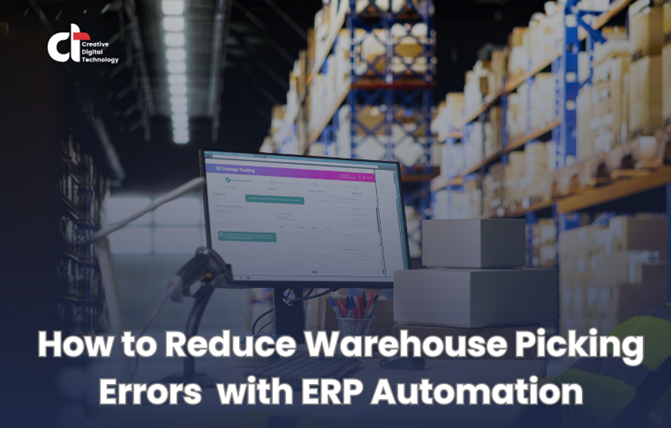
How to Reduce Warehouse Picking Errors by 40% with ERP Automation
Running a warehouse in today’s fast-paced e-commerce environment isn’t just challenging it’s downright demanding. If you’ve ever dealt with frustrated customers complaining about wrong items, delayed shipments, or missing products, you know exactly what we’re talking about. These issues often stem from one common culprit: picking errors in your warehouse operations.
Here’s the good news: modern inventory management solutions, particularly Enterprise Resource Planning (ERP) systems with integrated warehouse management capabilities, can dramatically reduce these costly mistakes. As a result, businesses like ABC Distribution have achieved up to 60% reduction in picking errors after implementing the right ERP system.
So, how can ERP automation transform your warehouse from a source of headaches into a well-oiled machine? Let’s dive in.

Understanding the Cost of Warehouse Picking Errors
Before we explore solutions, it’s important to understand what you’re up against. Picking errors don’t just frustrate customers they hit your bottom line hard.
The Hidden Costs You're Paying
First and foremost, there’s the immediate cost of returns processing, restocking, and reshipping the correct items. Subsequently, you’re dealing with customer dissatisfaction, which can lead to negative reviews and lost future sales. Beyond that, your team wastes valuable time tracking down errors, investigating what went wrong, and implementing temporary fixes that never quite solve the underlying problem.
Manual inventory tracking systems compound these issues. Without real-time visibility into stock levels, your warehouse staff often works with outdated information, leading to overselling, stockouts, and further picking confusion.

What is ERP and How Does it Revolutionize Inventory Management?
At its core, an ERP system (Enterprise Resource Planning) is comprehensive business management software that integrates all aspects of your operations from finance and accounting to supply chain and warehouse management into one unified platform.
ERP Warehouse Management System: Your Digital Command Center
When we talk about ERP warehouse management systems, we’re referring to sophisticated modules within your ERP that specifically handle inventory tracking, order fulfillment, and warehouse operations. Think of it as your digital command center, giving you complete visibility and control over everything happening in your warehouse.
Unlike traditional inventory tracking systems that operate in isolation, modern ERP solutions connect your warehouse operations to your entire business ecosystem. This means when a customer places an order online, your ERP system immediately updates inventory levels, generates optimized pick lists, and triggers the fulfillment process all automatically.
How ERP Automation Reduces Picking Errors: The Mechanics
Now, let’s get into the practical details. How exactly does an automated inventory tracking system within your ERP reduce those frustrating picking errors?
1. Barcode Scanning and Real-Time Verification
Manual picking relies on human memory and visual identification two notoriously unreliable methods, especially when workers are rushing through hundreds of orders daily. Fortunately, however, ERP systems equipped with barcode scanning capabilities introduce a fail-safe verification step that changes everything.
Here’s exactly how it works: First, each product in your warehouse gets a unique barcode. Next, when a picker receives an order, the ERP generates an optimized pick list on a handheld device. Then, as the worker selects each item, they scan its barcode. Almost immediately, the system verifies whether it’s the correct item. If it’s wrong, the device alerts them instantly — thereby preventing the error before it ever reaches the customer.
Ultimately, therefore, this simple yet powerful technological intervention effectively eliminates the vast majority of picking mistakes caused by similar-looking products or human oversight. In other words, what once required flawless human attention can now be reliably handled by an automated, foolproof system.
2. Automated Pick Lists with Optimized Paths
Traditional warehouse operations often involve workers wandering through aisles, manually locating items based on handwritten or printed lists. As a result, this approach is not only inefficient but also highly error-prone.
By contrast, inventory management software within an ERP system generates intelligent, automated pick lists that organize items by location, thereby creating the most efficient route through your warehouse. Consequently, this means your pickers follow an optimized path, significantly reducing travel time and fatigue — both of which, in turn, contribute to errors.
Furthermore, the system continuously updates these lists in real-time. For instance, if inventory moves or stock runs low in one location, the ERP automatically and immediately adjusts, seamlessly directing workers to alternative picking locations without missing a beat.
Altogether, what was once a chaotic and time-consuming process becomes a streamlined, well-coordinated operation — simply by leveraging the power of intelligent automation.

3. Lot and Serial Number Tracking
For businesses dealing with products that have expiration dates, batch numbers, or serial numbers, manual tracking becomes exponentially complex. An ERP inventory management system handles this complexity effortlessly.
The system automatically tracks lot numbers and expiration dates, ensuring first-in-first-out (FIFO) picking for perishable goods. It also maintains complete traceability, so if there’s ever a product recall or quality issue, you can instantly identify which orders received which specific batches.
4. Real-Time Inventory Accuracy
Perhaps the most transformative aspect of automated inventory management is real-time inventory accuracy. Traditional systems rely on periodic physical counts, meaning your inventory data is often outdated. This leads to situations where pickers are sent to locations with insufficient stock, causing delays and confusion.
With an ERP system, every movement receiving, picking, returns, adjustments updates inventory counts instantly. This real-time visibility means your warehouse staff always works with accurate information, dramatically reducing errors caused by discrepancies between system records and actual stock.
The Productivity Benefits of ERP Warehouse Automation
Beyond error reduction, implementing an inventory management system delivers substantial productivity gains across your entire warehouse operation.
Faster Order Fulfillment
First, optimize pick paths reduce the distance workers travel. Second, real-time inventory visibility eliminates time wasted searching for products or dealing with stockouts. Third, automated workflows remove bottlenecks in the approval and processing stages.
The cumulative effect? Orders move from “placed” to “shipped” significantly faster, improving customer satisfaction and enabling your business to handle higher order volumes without proportionally increasing labor costs.
Enhanced Labor Productivity
Importantly, this isn’t about making workers work harder it’s about making their work easier and more efficient.
With clear, optimized pick lists displayed on handheld devices, workers spend less time thinking about what to do next and more time actually doing it. Meanwhile, the system guides them through each task step-by-step, reducing mental fatigue and decision-making burden.
Additionally, by eliminating the time spent fixing errors, returning mispicked items, and processing customer complaints, your team can focus on value-adding activities rather than damage control.
Improved Inventory Accuracy
Your purchasing team can make better decisions about reordering, avoiding both stockouts and excess inventory. Meanwhile, the finance department gets reliable data for accurate valuations. Similarly, sales teams can confidently promise delivery dates knowing the inventory data they’re seeing is current.
Addressing Common Inventory Management Issues with ERP
Even the best inventory tracking systems face challenges. However, ERP solutions specifically address the most common inventory management issues that plague warehouses.
Current Issues in Inventory Management
Many warehouses struggle with:
- Stock discrepancies: Physical inventory doesn’t match system records
- Slow stock turnover: Products sit too long, tying up capital and warehouse space
- Poor visibility: Management can’t see what’s happening in real-time
- Seasonal demand fluctuations: Difficulty predicting and preparing for demand spikes
- Multiple location complexity: Managing inventory across different warehouses or zones
- Returns processing: Handling returns efficiently while maintaining accurate counts
Explore current issues in inventory management and their solutions
How ERP Systems Solve These Challenges
A comprehensive ERP system tackles these issues through integrated functionality:
First, cycle counting features replace time-consuming annual physical inventories with regular, automated counts of smaller inventory segments, maintaining accuracy without major operational disruptions.
Additionally, demand forecasting tools analyze historical sales data and identify trends, helping you prepare for seasonal fluctuations and avoid both stockouts and overstock situations.
Furthermore, multi-location inventory management gives you unified visibility across all warehouse locations, distribution centers, and retail stores, enabling intelligent stock transfers and balanced inventory distribution.
Integrated returns management processes returns efficiently, immediately updating inventory counts and quality status, while providing insights into return patterns that might indicate quality issues or listing errors.
Choosing the Right ERP for Your Warehouse
Not all inventory management software solutions are created equal. When selecting an ERP system for your warehouse, consider these critical factors.
Essential Features to Look For
The best inventory management software for warehouses should include:
- Mobile compatibility: Warehouse workers need access to the system via handheld devices or tablets, not just desktop computers.
- Barcode/RFID scanning: Without this feature, you’ll miss the primary benefit
- Integration capabilities: Otherwise, you’ll still face manual data entry connect with your e-commerce platforms, shipping carriers, and accounting systems.
- Scalability: Therefore, you won’t need to replace it with your business, handling increased order volumes and additional warehouse locations.
- User-friendly interface: Complex systems that require extensive training reduce adoption rates and effectiveness.
Robust reporting: Access to real-time dashboards and customizable reports helps you make data-driven decisions.

Commercial vs. Custom Solutions
You’ll encounter both commercial off-the-shelf inventory management software and custom solutions designed specifically for your business needs.
Commercial solutions like best inventory management software packages offer faster implementation, proven functionality, and regular updates. They’re ideal for businesses with relatively standard warehouse operations.
However, if your warehouse has unique processes, highly specialized inventory requirements, or operates in a niche industry, a customized ERP inventory management system might better serve your needs, despite higher upfront costs and longer implementation timelines.
Implementation: Making ERP Automation Work for You
Even the most sophisticated enterprise resource planning ERP system won’t deliver results if implementation is mishandled. Success requires careful planning and execution.
The Implementation Roadmap
Phase 1: Assessment and Planning (Weeks 1-4)
Begin by documenting your current warehouse processes, identifying pain points, and establishing clear goals. What specific problems are you trying to solve? What metrics will indicate success?
Phase 2: System Configuration (Weeks 5-12)
Next, work with your ERP provider to configure the system for your specific warehouse layout, product types, and operational workflows. This includes setting up location hierarchies, defining picking strategies, and configuring automation rules.
Phase 3: Data Migration (Weeks 10-14)
During weeks 10-14, transferring existing inventory data into your new ERP system requires meticulous attention to detail. Clean up data inconsistencies in your current system before migration to avoid bringing problems into your new platform.
Phase 4: Training and Testing (Weeks 13-16)
Comprehensive training is essential . Your warehouse team needs hands-on experience with the new system before going live. Run parallel operations, where possible, to compare results and build confidence.
Phase 5: Go-Live and Optimization (Week 17+)
After launching, monitor performance closely. Gather feedback from users, identify bottlenecks, and continuously optimize workflows. Remember, ERP implementation isn’t a one-time event—it’s an ongoing process of refinement.
Common Implementation Pitfalls to Avoid
Many businesses struggle with ERP warehouse management system implementations due to avoidable mistakes:
- Insufficient training: Rushing training or only training supervisors creates knowledge gaps that undermine system effectiveness.
- Ignoring change management: Technology is only half the battle. People resist change, so address concerns, communicate benefits clearly, and celebrate early wins.
- Over-customization: While some customization is valuable, excessive modifications complicate updates and increase maintenance costs.
- Neglecting data quality: “Garbage in, garbage out” applies to ERP systems. Poor data quality in your old system will corrupt your new one.
Beyond ERP: Complementary Strategies for Error Reduction
While an inventory management system addresses about 90% of operational inefficiencies, achieving optimal warehouse performance requires a holistic approach.
Physical Warehouse Design
Even the best automated inventory management system can’t overcome poor warehouse layout. Consider:
- Logical product placement: Position high-velocity items near packing stations to minimize travel time.
- Clear signage and labeling: Make locations easy to identify quickly.
- Adequate lighting: Poor visibility contributes to picking errors.
Ergonomic considerations: Reduce worker fatigue by optimizing shelf heights and minimizing repetitive strain.
Workforce Development
Invest in your team alongside your technology:
- Continuous training: Product knowledge reduces errors when workers can identify items confidently.
- Performance incentives: Recognize accuracy and productivity improvements.
- Error analysis: When errors occur, treat them as learning opportunities rather than simply assigning blame.
Quality Control Checkpoints
Implement verification stages:
- Random spot-checks: Periodically verify picks before packing.
- Packing station verification: Final visual confirmation before shipping.
- Customer feedback loops: Monitor returns and complaints to identify recurring issues.
The ROI of ERP Automation: Making the Business Case
Investing in an ERP inventory management system requires significant capital, so understanding the return on investment is essential.
Calculating Your Potential Savings
Consider these key factors when estimating ROI:
Error reduction savings: First and foremost, calculate the current cost of picking errors, including returns processing, restocking labor, reshipping costs, and customer retention impact. For example, if you process 10,000 orders monthly with a 5% error rate (500 errors), and each error costs $25 to resolve, you’re consequently spending $12,500 monthly or $150,000 annually on entirely preventable mistakes.
As a direct result, a 60% error reduction — matching ABC Distribution’s impressive results — would therefore save $90,000 annually from this category alone.
Labor efficiency gains: Similarly, if a 20% productivity increase allows your team to handle 20% more volume without adding staff, or if it ultimately eliminates the need for one full-time position, you can then calculate those savings against your current labor costs.
Inventory carrying cost reductions: Beyond that, improved accuracy simultaneously reduces both stockouts (lost sales) and overstock (tied-up capital and storage costs). In fact, even a modest 10% reduction in average inventory levels can consequently free up substantial working capital.
Customer lifetime value impact: Finally, and perhaps most importantly, fewer errors mean happier customers, better reviews, and higher retention rates. While this metric is admittedly harder to quantify, it is nevertheless potentially the most valuable long-term benefit of all.
Taken together, these interconnected factors paint a compelling picture of just how significant — and measurable — the return on investment from ERP implementation can truly be.
Typical Payback Periods
For mid-sized warehouses, ERP warehouse management systems typically achieve payback within 12-24 months, with benefits continuing to compound over subsequent years.
Smaller operations might see faster payback periods due to lower implementation costs, while very large, complex warehouses might require longer timelines but ultimately achieve greater absolute savings.
Frequently Asked Questions (FAQ)
A standalone Warehouse Management System (WMS) focuses exclusively on warehouse operations receiving, putaway, picking, packing, and shipping. An ERP system includes warehouse management as one module within a broader platform that also handles accounting, purchasing, sales, customer relationship management, and other business functions.
The key advantage of an integrated ERP warehouse management system is seamless data flow between departments. When your warehouse, accounting, and sales teams all work from the same unified database, you eliminate data discrepancies and reduce redundant data entry.
Absolutely. While enterprise-level ERP systems can be complex and expensive, many providers now offer scaled-down versions or cloud-based solutions designed specifically for small to mid-sized businesses.
In fact, smaller operations often see faster ROI because they’re not dealing with the change management challenges of large organizations. Additionally, implementing strong inventory management practices early prevents the bad habits and workarounds that become entrenched in growing businesses without proper systems.
Implementation timelines vary based on business complexity, but typical ranges are:
- Small warehouses (1 location, <50 employees): 8-16 weeks
- Mid-sized operations (2-3 locations, 50-200 employees): 16-24 weeks
- Large enterprises (multiple locations, 200+ employees): 24-52 weeks
These timelines assume proper planning, adequate resources, and realistic scope definition. Rushed implementations inevitably lead to problems, so resist pressure to shorten timelines excessively.
Change resistance is natural and expected. Overcome it through:
- Early involvement: Include end-users in the selection and configuration process.
- Clear communication: Explain how the system makes their jobs easier, not just how it benefits the company.
- Comprehensive training: Ensure everyone feels confident using the new system.
- Visible leadership support: When executives demonstrate commitment, teams follow.
- Patience: Allow time for adjustment and be responsive to legitimate concerns.
Not necessarily. Cloud-based ERP systems minimize IT infrastructure requirements, as the vendor handles servers, updates, and technical maintenance.
However, you may want to designate an internal “system administrator” someone who becomes the expert on your ERP configuration and serves as the primary contact with your vendor. This person doesn’t need to be a programmer, but should be tech-savvy and understand your business processes well.
Most modern inventory management software solutions offer pre-built integrations with popular e-commerce platforms (Shopify, WooCommerce, Magento, BigCommerce, etc.) and marketplace sellers (Amazon, eBay, Walmart).
These integrations automatically sync orders, update inventory levels across all channels, and feed tracking information back to your customers eliminating manual data entry and reducing errors caused by disconnected systems.
Reputable ERP providers build redundancy and backup systems to minimize downtime risk. Cloud-based solutions typically offer 99.9% uptime guarantees.
However, you should still maintain contingency plans:
- Offline capabilities: Some systems allow basic functionality when internet connectivity is lost.
- Backup procedures: Manual processes for critical operations during extended outages.
- Local data backups: Regular exports of essential data.
- Clear escalation procedures: Know how to quickly contact vendor support for urgent issues.
Implementing an ERP warehouse management system represents a significant investment in your business’s future. However, navigating the selection, implementation, and optimization process can be overwhelming, especially when you’re simultaneously trying to maintain daily operations.
At CDT, we specialize in helping businesses like yours leverage technology to overcome operational challenges. Our team has extensive experience implementing inventory management systems across diverse industries, from e-commerce warehouses to manufacturing facilities to distribution centers.
We don’t just install software and walk away. Instead, we partner with you throughout the entire journey:
Discovery and Assessment: We begin by thoroughly understanding your current processes, pain points, and goals. What makes your warehouse unique? What specific problems need solving? This assessment ensures we recommend solutions tailored to your actual needs, not just the most expensive options.
Solution Selection: With hundreds of ERP systems available, choosing the right one is daunting. We leverage our industry knowledge and vendor relationships to identify solutions that match your requirements, budget, and technical capabilities.
Implementation Management: Our project managers guide you through every implementation phase, from initial configuration to data migration to go-live support. We’ve seen what works and what doesn’t, helping you avoid common pitfalls.
Training and Change Management: Technology only delivers results when people use it effectively. Our training programs ensure your team not only knows how to operate the system but understands why certain processes exist and how to optimize them.
Ongoing Support and Optimization: After implementation, we remain available to address questions, troubleshoot issues, and help you continuously improve warehouse performance as your business evolves.
Our clients have achieved transformative results
A food distributor reduced spoilage by 40% through better lot tracking and FIFO enforcement
- A fashion retailer cut inventory carrying costs by 25% while improving in-stock rates
- An industrial supplier eliminated 90% of shipping errors through barcode verification
These aren’t aspirational goals they’re documented outcomes from businesses that invested in proper inventory management technology and implementation support.
If you’re tired of dealing with picking errors, inventory discrepancies, and operational inefficiencies, it’s time to explore how an ERP warehouse management system can transform your operations.
Contact CDT today for a complimentary warehouse operations assessment. We’ll analyze your current processes, identify opportunities for improvement, and provide concrete recommendations—with no obligation.
Warehouse picking errors aren’t just inconvenient they’re expensive, frustrating, and completely preventable with the right technology. As ABC Distribution demonstrated, implementing an ERP inventory management system can reduce picking errors by 60% or more while simultaneously improving productivity, inventory accuracy, and customer satisfaction.
The question isn’t whether automation will transform warehouse operations it already has for forward-thinking businesses. The real question is whether you’ll embrace these tools now and gain a competitive advantage, or wait until you’re struggling to keep pace with more efficient competitors.
Modern inventory management technology has reached a maturity level where implementation is faster, costs are more accessible, and ROI is more predictable than ever before. With cloud-based solutions, even small warehouses can access enterprise-grade capabilities without massive infrastructure investments.
However, success requires more than just purchasing software. You need the right system for your specific needs, proper implementation methodology, comprehensive training, and ongoing optimization. This is where partnering with experienced professionals like CDT makes the difference between a successful transformation and a frustrating false start.
Your warehouse is the heart of your fulfillment operation. When it runs efficiently, your entire business benefits through happier customers, healthier margins, and more scalable growth. Conversely, when warehouse operations struggle, every other department feels the pain.
Isn’t it time to stop fighting picking errors and start preventing them? Reach out to CDT today, and let’s discuss how ERP warehouse automation can transform your operations from a daily challenge into a competitive advantage.
CDT specializes in helping businesses implement and optimize ERP and inventory management solutions. With decades of combined experience and hundreds of successful implementations, we’re your trusted partner for warehouse transformation.
Ready to reduce warehouse picking errors? Contact CDT and discover how the right ERP system can revolutionize your operations.
Software development life cycle
why the software development life cycle is critical for businesses to build secure, scalable, and high-quality software solutions.

How Cloud-Based ERP Is Changing Business Operations
Find out how cloud ERP can simplify your workflow, reduce costs, and help your team make smarter decisions.