



How Cloud-Based ERP Is Changing Business Operations
Over 60% of businesses are expected to move their ERP systems to the cloud by 2026.This shift isn’t just a passing trend, it’s a strategic transformation driven by the need for flexibility, scalability, and smarter decision-making. As digital transformation becomes a necessity rather than a choice, organizations are recognizing that traditional ERP systems can’t keep pace with today’s dynamic business environment.
Managing operations with on-premise systems is slowing businesses down. Legacy ERP setups often lead to disconnected data, manual processes, delayed reporting, and higher maintenance costs. These inefficiencies create bottlenecks that limit growth and make it harder for companies to respond to change in real time. In an era defined by agility and speed, sticking to outdated systems can quickly turn into a competitive disadvantage.
Imagine running your entire business – finance, HR, supply chain from a single dashboard, accessible anywhere. That’s the promise of cloud-based ERP. By bringing every function under one unified, cloud-hosted system, businesses gain real-time visibility, enhanced collaboration, and freedom from the constraints of physical infrastructure. Teams can work smarter, executives can make informed decisions faster, and IT departments can focus more on innovation than maintenance.
The Evolution of ERP in the Cloud Era
Enterprise Resource Planning systems have long been the backbone of business operations, integrating key functions like finance, HR, procurement, and supply chain into one centralized platform. Traditionally, these systems were hosted on-premise, requiring companies to invest heavily in servers, storage, and IT support to maintain and upgrade them.
However, the rise of cloud computing and SaaS (Software as a Service) has redefined how ERP systems operate. Instead of managing costly infrastructure, organizations can now subscribe to cloud-based ERP platforms that are hosted, maintained, and continuously updated by the vendor. This shift allows businesses to operate with greater efficiency, scalability, and cost control.
According to a report by NetSuite, more than 60% of organizations are either in the process of moving or planning to migrate their ERP systems to the cloud within the next few years, a clear sign of where the market is headed.
What Is a Cloud-Based ERP?
It is an enterprise management system hosted on the cloud that integrates all core business processes in one place. Unlike traditional Enterprise Resource Planning systems that require on-premise servers and manual updates, cloud ERP is accessible anytime, anywhere, typically through a web browser or mobile app
| Feature | On-Premise ERP | Cloud-Based ERP |
| Infrastructure | Installed locally on company servers | Hosted by vendor on cloud infrastructure |
| Accessibility | Restricted to physical office networks | Accessible from anywhere, on any device |
| Maintenance | Managed internally by IT teams | Automatically updated by vendor |
| Scalability | Limited by hardware and budget | Easily scalable with business growth |
| Cost Model | High upfront capital investment | Subscription-based, lower initial cost |
This structure not only reduces IT overhead but also ensures that the organization is always running on the latest version of the software without disruptions or costly upgrades.
How Cloud-Based ERP Is Changing Business Operations
1. Enhanced Accessibility and Remote Collaboration
Cloud ERP allows employees to access data and applications from anywhere, whether they’re in the office, at home, or on the go. This accessibility fosters real-time collaboration across teams and geographies, making it easier to coordinate operations, share insights, and respond to challenges quickly.
In a post-pandemic world where remote and hybrid work models are becoming the norm, this flexibility has become one of the biggest competitive advantages for businesses.
2. Real-Time Insights and Decision-Making
Traditional Enterprise Resource Planning systems often suffer from data silos and delayed updates. Cloud ERP eliminates these issues by centralizing all data in real time. Decision-makers can monitor performance, track key metrics, and identify trends instantly through intuitive dashboards.
This real-time visibility helps organizations react to market changes faster and make smarter, data-driven decisions.
3. Scalability and Agility
One of the most significant benefits of cloud-based ERP is scalability. As your business grows, your ERP system grows with it without the need for additional hardware or complex installations. Whether you’re adding users, expanding to new locations, or launching new products, cloud ERP adjusts seamlessly to your needs.
4. A Real-World Comparison: From On-Premise to Cloud ERP
While the advantages of cloud-based ERP are clear in theory, the performance difference becomes even more compelling when you look at it side by side.
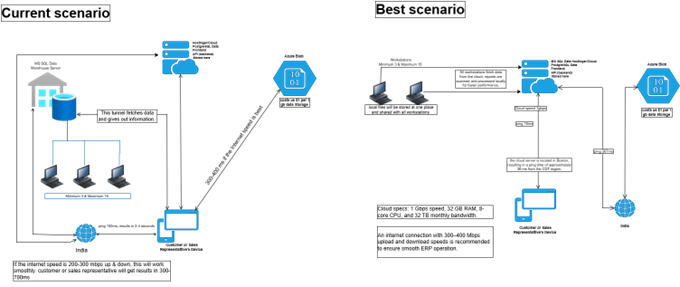
Below is a simplified visual comparison between two common ERP environments: the current on-premise setup and the best-case cloud scenario based on real infrastructure performance and connectivity benchmarks.
Current Scenario
In a traditional, on-premise ERP setup, data is stored locally on company servers and accessed through internal tunnels or VPNs. This model often results in delayed response times, complex maintenance, and higher hardware costs.
Best Scenario
In a cloud-based ERP configuration, all workstations connect directly to secure, high-speed cloud servers. Local files are synced automatically, reports are generated faster, and performance remains consistent across devices and locations.
Cloud hosting also eliminates the need for heavy on-site infrastructure and ensures that updates, backups, and scaling are handled seamlessly by your service provider.
💡 For smooth ERP performance, we recommend at least a 300–400 Mbps upload/download connection to ensure consistent, real-time operation across teams.
The takeaway:
Migrating from an on-premise ERP to a cloud-based system results in faster data access, improved collaboration, and lower operational overhead creating a stronger foundation for business growth and digital transformation.
5. Integration with Other Cloud Services
Modern businesses rely on interconnected systems from CRM and HR software to analytics and cloud storage solutions. Cloud ERP easily integrates with these platforms, creating a connected ecosystem that enhances productivity and efficiency.
For example, integration with Azure Blob Storage or other cloud services enables seamless data management and real-time reporting across applications.
Key Benefits of Moving to Cloud ERP
- Improved agility – Quickly adapt to business or market changes.
- Better collaboration - Unified data across departments improves communication and teamwork.
- Lower costs – No need for expensive infrastructure or hardware maintenance.
- Faster innovation – Automatic updates ensure access to the latest tools and features.
- Enhanced security – Leading ERP vendors provide robust encryption and compliance measures.
- Support for remote work – Access systems securely from any device, anywhere.
- Scalable growth – Add or remove features and users as your business evolves.
Checklist for Choosing a Cloud ERP Provider:
- Proven experience with cloud architecture
- Strong data security measures and compliance standards
- Transparent pricing and flexible plans
- Reliable customer support and training resources
- Industry-specific capabilities (if needed)
The Future of ERP: Smarter, Connected, and Cloud-Driven
The future of Enterprise Resource Planning systems lies in AI-powered automation, predictive analytics, and deeper integration across business ecosystems. Cloud ERP systems are evolving into intelligent platforms capable of forecasting demand, automating routine tasks, and offering actionable insights before issues arise.
As more organizations embrace cloud ERP, the line between back-office systems and strategic tools is blurring. ERP is no longer just about resource planning; it’s about driving digital transformation and enabling smarter, connected enterprises.
Conclusion
The way businesses operate is changing, and cloud-based ERP is leading that transformation. With improved accessibility, scalability, and real-time insights, organizations can manage every aspect of their operations from a single, unified platform.
Companies that adopt cloud ERP today are building the foundation for agility and growth tomorrow. Those that continue relying on outdated systems risk falling behind in an increasingly competitive, digital-first world.
If your organization is looking to modernize its operations, enhance efficiency, and stay ahead of the curve, now is the time to explore the benefits of cloud-based Enterprise Resource Planning systems.