


Cloud ERP Software India: How It Is Changing Business Operations
The business landscape is shifting rapidly. For modern enterprises, relying on outdated, on-premise systems is no longer an option. This is where Cloud ERP Software India is making a massive impact. As digital transformation sweeps across the country, businesses from Mumbai to Bangalore are adopting cloud-based Enterprise Resource Planning (ERP) to stay competitive.
In this post, we explore how this technology is reshaping operations and why choosing the right Cloud ERP Software India is critical for your growth.
Introduction: From Optional to Operational Survival
In the rapidly evolving digital landscape of 2025, operating a business on legacy software is no longer just a “slow” choice—it is a survival risk. Recent industry data suggest that over 60% of businesses will migrate their core ERP systems to the cloud by 2026. This mass migration isn’t a trend; it’s a fundamental shift in the “digital nervous system” of modern enterprise.
For Indian SMEs and large enterprises alike, the question has shifted from “Should we move to the cloud?” to “How quickly can we migrate?” Whether you are a textile manufacturer in Surat or a tech startup in Bangalore, the ability to access real-time data, automate GST compliance, and scale operations without buying new servers is the new competitive baseline.
In this guide, we explore exactly how Cloud-Based Enterprise Resource Planning (ERP) is rewriting the rules of business operations, offering a detailed look at costs, security, and the manufacturing revolution.
1. Beyond the Basics: Real-Time Data & Remote Agility
The traditional ERP model was rigid: installed on office computers, accessible only during work hours, and often weeks behind on data. Cloud ERP shatters these limitations.
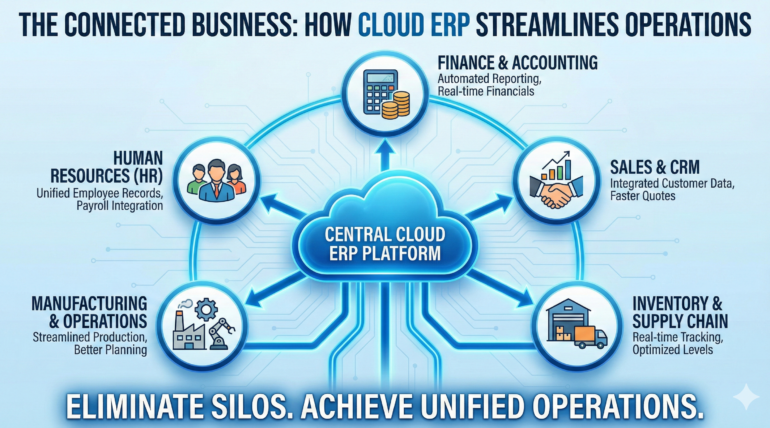
The “Single Source of Truth” Cloud ERP centralizes data from every department—finance, HR, procurement, and sales—into one live database.
No More Data Silos: When a sales representative closes a deal in Mumbai, the inventory levels in the Gujarat warehouse update instantly.
Faster Decision Making: Executives no longer need to wait for “end-of-month” reports. Dashboards provide real-time P&L, cash flow, and stock status, enabling agile responses to market volatility.
The “Work from Anywhere” Reality Post-2020, the hybrid work model is permanent. Cloud ERP allows secure access via browser or mobile app.
Field Sales: Teams can check stock and place orders from a client’s office.
Remote Management: Business owners can approve Purchase Orders (POs) or check daily sales from their phone while traveling.
2. The Financial Case: Cloud vs. On-Premise ERP
For many Indian businesses, cost is the deciding factor. There is a common misconception that Cloud ERP is “expensive” because of its monthly fees. However, when analyzing the Total Cost of Ownership (TCO) over 3-5 years, Cloud ERP often proves more economical.
CapEx vs. OpEx
On-Premise (CapEx): Requires heavy upfront capital for physical servers, cooling systems, backup generators, and software licenses.
Cloud (OpEx): operates on a “Pay-As-You-Go” subscription model. You pay only for the users and modules you need, freeing up capital for business growth.
Table: Cost Comparison for an Indian SME (3-Year Horizon)
| Cost Component | On-Premise ERP | Cloud ERP |
| Upfront Hardware | High (Servers, Cabling, AC) | Zero (Hosted by Vendor) |
| Implementation Time | 3-6 Months | 2-4 Weeks |
| IT Staffing | Requires dedicated IT admin (₹5-10L/year) | Managed by Vendor (Included) |
| Upgrades/Maintenance | Expensive, manual, often skipped | Automatic & Free |
| Data Security | Your responsibility (High Risk) | Bank-grade Encryption (Vendor responsibility) |
| Scalability | Buy new hardware to grow | Click to add users instantly |
Data Source: Industry TCO Analysis
3. The Manufacturing Revolution: Industry 4.0 in India
The impact of Cloud ERP is most profound in the manufacturing sector. With the push for “Make in India,” manufacturers are using Cloud ERP to compete globally.
IoT and Predictive Maintenance Modern Cloud ERPs integrate with Internet of Things (IoT) sensors on factory floor machines.
Scenario: A CNC machine detects a vibration anomaly. Instead of waiting for it to break, the machine sends a signal to the Cloud ERP. The ERP automatically schedules maintenance and orders the spare part. This creates Zero Downtime operations.
Supply Chain Visibility In a volatile market, inventory control is cash control. Cloud ERPs help manufacturers:
Predict Demand: AI algorithms analyze historical sales to predict seasonal spikes (e.g., Diwali rush).
Vendor Portals: Suppliers can log in to view your stock levels and replenish automatically, reducing the administrative burden of procurement.
4. Navigating the Challenges: Security & Connectivity
Adopting new technology comes with valid concerns. Here is how modern Cloud ERPs address the top fears of Indian businesses.
Challenge 1: “Is my data safe in the cloud?”
Reality: Cloud providers (like AWS, Azure, or private cloud vendors) spend billions on security—far more than any individual SME can afford. Your data is protected by enterprise-grade firewalls, regular penetration testing, and geo-redundant backups (meaning if one server fails, another takes over instantly).
Challenge 2: “What if the internet goes down?”
Solution: Modern ERPs often feature “Offline Sync” capabilities. You can continue billing and working offline; the system automatically syncs data once connectivity is restored. Furthermore, with 5G rolling out across India, connectivity stability is at an all-time high.
5. Future Trends 2025: AI and Green ERP
Investing in Cloud ERP today is an investment in the future.
Agentic AI: The next generation of ERP won’t just report data; it will act on it. Imagine an ERP that notices a shipping delay and automatically emails the customer with an apology and a discount code.
ESG Reporting: As global export rules tighten, Indian businesses must report on carbon footprints. Cloud ERPs are now adding modules to track energy usage and waste, simplifying compliance for green manufacturing.
Frequently Asked Questions (FAQ)
A While Tally is excellent for basic accounting, Cloud ERP covers the entire business (Inventory, CRM, HR, Production). While the monthly subscription might appear higher, the elimination of hardware costs, annual maintenance contracts, and IT staff salaries often makes Cloud ERP cheaper in the long run.
A Yes. Modern Cloud ERPs are modular. Whether you are in textiles, pharmaceuticals, or retail, you can add specific modules and customize workflows without breaking the core system code.
A Unlike on-premise systems that take months, Cloud ERPs can often be deployed in 2-4 weeks, depending on the complexity of your data migration.
Ready to Future-Proof Your Business?
Don't let legacy software slow down your growth. At CDT Support, we specialize in helping businesses navigate their digital transformation with a free consultation on your ERP strategy.
Click Here