


AI Implementation Without the Hype:5 Practical Use Cases of AI Implementation
A no-nonsense guide to how artificial intelligence can solve real problems for wholesalers, retailers, and the customers they serve right now, not someday.
Why Businesses Are Finally Getting Serious About AI Adoption
Let’s be honest the word “AI” has been thrown around so much that it can feel more like a buzzword than a business tool. Every conference, every LinkedIn post, and every vendor pitch seems to include it. So, understandably, a lot of business owners and operators are left wondering: Is this actually useful for me?
The concise answer is yes but only if it’s done correctly. At CDT Software and Support, we’ve spent years building web and mobile solutions for USA-based wholesalers and their retail networks. What we’ve consistently seen is that the most successful businesses aren’t waiting for AI to become “mainstream.” They’re already using it in focused, practical ways that directly impact their bottom line.
In this blog, therefore, we’re going to cut through the noise. We’ll walk you through 5 real-world AI implementation use cases that are not only possible today they’re already changing how smart businesses operate. Moreover, we’ll explain what each one does, how it works, and why it matters.
Who is this for? Whether you’re a wholesaler managing thousands of SKUs, a retailer trying to understand your customers better, or a tech leader exploring an enterprise AI adoption strategy this guide is written for you.
What Does Artificial Intelligence Integration Actually Mean for a Business?
Before we dive into the use cases, it’s worth taking a moment to clarify what we actually mean by AI implementation. In simple terms, it’s the process of embedding AI or machine learning capabilities into your existing software, workflows, or products so that your systems can learn from data, make predictions, and automate decisions that previously required human effort.
Importantly, this doesn’t mean replacing your team. In reality, the benefits of AI implementation are most powerful when AI handles the repetitive, data-heavy tasks leaving your people free to focus on strategy, relationships, and growth.
Furthermore, AI integration isn’t limited to large enterprises with massive budgets. Thanks to advances in cloud computing and modern development frameworks, AI implementation in software development is now accessible to mid-sized businesses as well. As a result, businesses that act now gain a significant edge over those that wait.
5 Practical AI Implementation Use Cases for Wholesale & Retail
Use Case 01
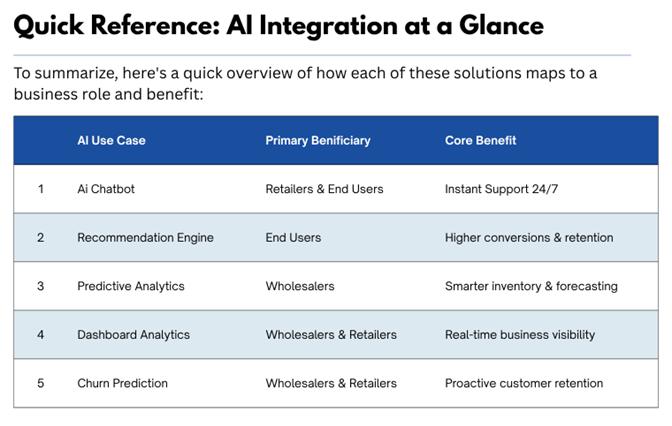
AI-Powered Chatbots: Always-On Support for Retailers & Wholesalers
Think about how much time your support or sales team spends answering the same questions over and over: order status, product availability, return policies, pricing tiers. Now imagine a system that handles all of that automatically, 24 hours a day, 7 days a week, without ever putting a customer on hold.
That’s exactly what an AI-powered chatbot does. And today, this isn’t just a rule-based FAQ bot; modern chatbots powered by generative AI can hold natural conversations, understand context, and escalate complex queries to a real human when needed. This is one of the clearest examples of implementing generative AI in business in a way that’s immediately visible to customers.
For wholesalers, a chatbot can be embedded into the retailer portal to answer stock queries, handle reorder requests, or walk a new retailer through onboarding. For retailers interacting with end users, the same technology works as a front-line customer support agent.
Why it matters:
- Reduces support ticket volume significantly
- Improves response time from hours to seconds
- Available across web, mobile, and messaging platforms
- Collects valuable interaction data for future improvements
24/7 Availability Cost Reduction Better Customer Experience
Use Case 02
Personalized Recommendation Engines: Show Every User Exactly What They Need
Have you ever noticed how Amazon always seems to show you something you actually want? That’s not magic it’s a recommendation engine powered by machine learning. And while building something Amazon-scale isn’t necessary, even a scaled-down version of this technology can dramatically improve how end users experience your platform.
A personalized recommendation system analyzes each user’s behavior what they browse, what they buy, how long they spend on a product page, and what they ignore and uses that data to surface the most relevant products or content at the right time. This is one of the most compelling examples of machine learning integration in consumer-facing applications.
For end users on a retail app, this means seeing products they’re actually likely to buy not just what’s popular overall, but what’s popular for them. For wholesalers, it translates to better product placement for retailers and higher order values.
Real impact you can measure:
- Higher average order value per session
- Lower bounce rates on product listing pages
- Increased repeat purchase rate
- Stronger brand loyalty over time
Quick insight: Businesses that use personalized recommendations see an average uplift of 10–30% in conversion rates, according to multiple industry studies. This is one of the most well-documented benefits of AI implementation in retail.
Higher Conversions Better UX Repeat Purchases
Use Case 03
Predictive Analytics: Anticipate What Will Sell Before It Happens
One of the most expensive problems in wholesale is stocking the wrong products either running out of fast-moving items or getting stuck with slow-moving inventory that ties up capital. Traditionally, businesses rely on historical sales data and gut instinct to forecast demand. But both of these approaches fall short in a dynamic market.
Predictive analytics — a core capability within intelligent system integration uses machine learning models to analyze historical sales patterns, seasonal trends, market signals, and even external data like weather or economic indicators, to forecast which products will move and when.
For a wholesaler, this means smarter procurement decisions, optimized warehouse space, and far fewer emergency restocks (or write-offs). In other words, your supply chain stops being reactive and becomes genuinely proactive. This is precisely the kind of real-world AI implementation that delivers ROI you can calculate.
What wholesalers gain:
- Accurate demand forecasting by product and region
- Early signals about emerging product trends
- Reduced overstock and understock situations
- Better negotiation leverage with suppliers
Inventory Optimization Cost Savings Supply Chain Efficiency
Use Case 04
AI-Driven Dashboard Analytics: From Raw Data to Actionable Decisions
Most businesses already collect a lot of data sales records, user activity logs, inventory levels, order histories. The problem, however, isn’t a lack of data. It’s that raw data sitting in spreadsheets or disconnected systems isn’t useful. You need a system that can turn that data into clear, timely, actionable insights.
An AI-enhanced analytics dashboard does exactly that. Rather than just showing you numbers, it highlights anomalies, surfaces trends, flags underperforming products, and even sends alerts when something needs your attention. This represents a meaningful step forward in enterprise AI adoption strategy moving from descriptive reporting to truly intelligent business intelligence.
For wholesalers, this could mean real-time visibility into which retailers are hitting targets, which product categories are underperforming, and where the most profitable growth opportunities are hiding. For retailers, the same tools can reveal peak purchase hours, bestsellers by location, and customer lifetime value trends.
Features a smart dashboard delivers:
- Real-time sales performance by product, region, or retailer
- Automated alerts for low stock, unusual returns, or sales dips
- Visual trend lines and comparative reporting
- Exportable reports for stakeholders and planning meetings
Faster Decisions Data Visibility Performance Tracking
Use Case 05
Churn Prediction: Identify At-Risk Users Before They Walk Away
Acquiring a new customer costs significantly more than retaining an existing one that’s a well-established business truth. Nevertheless, most businesses only notice they’ve lost a customer after it’s already happened. By that point, it’s too late to intervene.
Churn prediction flips this dynamic on its head. By continuously analyzing user behavior login frequency, purchase recency, browsing patterns, support interactions, and engagement signals an AI model can identify users who are showing early signs of disengagement. Consequently, your team can take action before that user leaves, rather than after.
For a wholesaler, this applies to retailer accounts who are ordering less frequently or exploring competitor options. For a retail platform, it identifies end users who are gradually drifting away. In either case, the AI-powered solution gives you a window of opportunity to reach out, offer an incentive, or address an unresolved issue and win back their loyalty.
This is one of the most sophisticated yet high-impact examples of AI implementation services that CDT Software can bring to your platform. Additionally, it directly improves customer lifetime value one of the most important metrics for sustainable growth.
Business outcomes:
- Proactive retention campaigns based on real risk scores
- Reduced customer acquisition costs (by retaining more of who you have)
- Improved NPS and customer satisfaction scores
- Clearer segmentation between loyal and at-risk accounts
Customer Retention Revenue Protection Smarter Engagement
How to Start Your AI Transformation Journey (Without Overwhelming Your Team)
One of the biggest reasons businesses hesitate on AI implementation is the fear that it’s too complex, too expensive, or too disruptive to their current systems. But in practice, a well-structured approach makes it entirely manageable especially when you have the right technology partner.
Here’s the framework we recommend at CDT Software:
- Start with one use case. Rather than trying to implement everything at once, pick the one AI capability that addresses your most pressing pain point right now. For most wholesalers, that’s predictive analytics or churn prediction. For retail-facing teams, it’s often the recommendation engine or chatbot.
- Audit your existing data. AI models are only as good as the data they’re trained on. Before building anything, therefore, take stock of what data you already have sales history, user activity logs, support tickets, and identify gaps.
- Choose the right integration approach. Depending on your current stack, AI implementation in software development can happen through APIs, embedded ML models, or third-party platforms integrated into your existing app. Each has tradeoffs in speed, cost, and control.
- Measure clearly from Day One. Define the metrics you want to move churn rate, average order value, support resolution time before you build. This ensures your team stays focused and you can demonstrate ROI to stakeholders.
- Iterate and expand. The beauty of an enterprise AI adoption strategy is that each use case builds on the last. Once your team is comfortable with the first deployment, adding the next one becomes progressively easier.
CDT Software Perspective: Having built full-stack platforms for wholesale and retail clients across the USA, we’ve seen firsthand how even modest AI implementation starting with a single, well-scoped feature can generate measurable returns within the first 60–90 days of deployment. The key is always specificity: solve a real problem, measure it, and build from there.
Final Thoughts: AI Solutions Are a Competitive Advantage, Not a Luxury
The businesses that will lead their industries in the next three to five years aren’t necessarily the ones with the biggest teams or the largest budgets. Rather, they’re the ones making smarter decisions, faster powered by data and intelligent systems.
The real-world AI implementation use cases we’ve covered in this blog chatbots, recommendation engines, predictive analytics, dashboard intelligence, and churn prediction are not futuristic concepts. They are available today, they are affordable at scale, and they are already being used by forward-thinking businesses in the wholesale and retail space.
Furthermore, implementing generative AI in business doesn’t have to mean a multi-year overhaul. When approached pragmatically, with the right development partner and a clear roadmap, the transition is incremental, manageable, and most importantly worth it.
At CDT Software and Support, our AI implementation services are designed specifically for businesses in the wholesale and retail space. We understand your workflows, your data structures, and your customers because we’ve already built the platforms they run on.
So if you’re ready to move from wondering “should we implement AI?” to actually doing it we’re here to help you take that first, practical step.
Frequently Asked Questions (FAQ)
Regular software follows fixed rules it does exactly what it’s programmed to do. AI implementation, on the other hand, means adding systems that can learn from data, recognize patterns, and make decisions or predictions on their own. For example, a standard inventory system tells you what’s in stock. An AI-powered one tells you what you’re likely to run out of next week before it happens.
Absolutely not AI is no longer just for big corporations with massive budgets. Thanks to modern cloud infrastructure and accessible APIs, even mid-sized wholesalers and retailers can implement AI features in a cost-effective way. In fact, starting small with one focused use case like a chatbot or a recommendation engine is often the smartest approach for growing businesses.
It depends on the complexity of the feature and the state of your existing data. A chatbot integration, for instance, can go live in a few weeks. A full predictive analytics system with custom ML models may take 2–4 months to build, train, and deploy properly. At CDT Software, we always begin with a scoping phase to give you a clear, realistic timeline before any development starts.
Having clean, organized historical data definitely helps — especially for use cases like predictive analytics and churn prediction. However, you don’t need years of data to get started. Some AI features, like chatbots and recommendation engines, can be trained on relatively modest datasets and improve over time as they collect more real-world interactions. The key is to start and let the system learn as your business grows.
For most wholesalers, predictive analytics delivers the fastest and most measurable ROI because smarter inventory decisions directly reduce costs. Churn prediction is a close second, especially if you’re managing a large retailer network and need to protect your key accounts. We recommend starting with whichever use case addresses your biggest pain point right now, and building from there.
CDT Software offers end-to-end AI implementation services tailored for wholesale and retail businesses including chatbot development, personalized recommendation engines, predictive demand forecasting, AI-powered dashboard analytics, and churn prediction systems. Since we’ve already built the web and mobile platforms many of our clients run on, integrating these AI capabilities is seamless, targeted, and built around your actual data and workflows.