


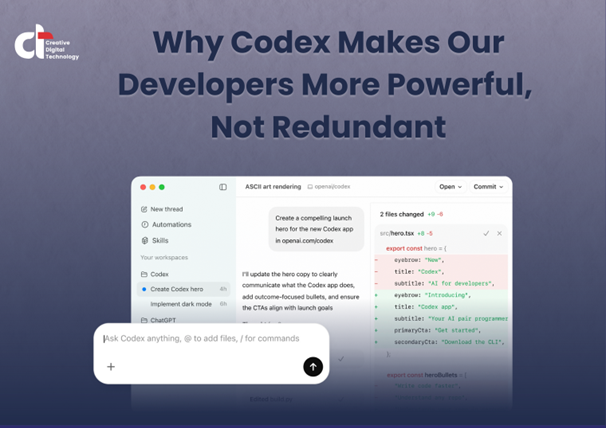
Why Codex Makes Our Developers More Powerful, Not Redundant
The rise of artificial intelligence has sparked countless debates about automation and job displacement. In the software development world, this conversation intensified with the emergence of AI code generators like OpenAI’s Codex. However, at CDT, we’ve discovered something remarkable: Codex doesn’t replace our developers it makes them exponentially more powerful.
After integrating this AI-powered code generation tool into our workflow, we’ve witnessed firsthand how it transforms the development process. Rather than threatening jobs, Codex amplifies human creativity, accelerates productivity, and enables our team to tackle more ambitious projects for our clients. Let’s explore why this technology represents an evolution in development capabilities, not a replacement.
What is Codex? Understanding the AI Code Generator Revolution
Before diving into the benefits, it’s essential to understand what Codex actually is. Developed by OpenAI, Codex is a sophisticated AI system trained on billions of lines of code and natural language text. Think of it as a highly intelligent assistant that understands both human language and programming languages.
At its core, this AI code generator can:
- Convert plain English descriptions into functional code across multiple programming languages
- Translate code from one programming language to another (for example, converting Python scripts to JavaScript)
- Explain existing code in simple, understandable terms for documentation or knowledge transfer
- Identify bugs and suggest fixes, accelerating the debugging process
- Generate comprehensive test cases and documentation automatically
Essentially, Codex serves as a bridge between human intent and machine execution. You describe what you want in natural language, and the AI code generator produces working code that accomplishes that goal. This capability has become the foundation for tools like GitHub Copilot and powers numerous development automation platforms.
Eliminating Repetitive Tasks
Software development involves significant amounts of boilerplate code repetitive patterns that must be written but don’t require creative problem-solving. Codex excels at generating this standardized code instantly. Whether it’s creating REST API endpoints, database models, or form validation logic, the AI code generator handles these routine tasks in seconds rather than minutes or hours.
Consequently, our developers spend less time on mundane tasks and more time on complex problem-solving and architectural decisions. This shift has been transformative for team morale and project outcomes.
Rapid Prototyping and Experimentation
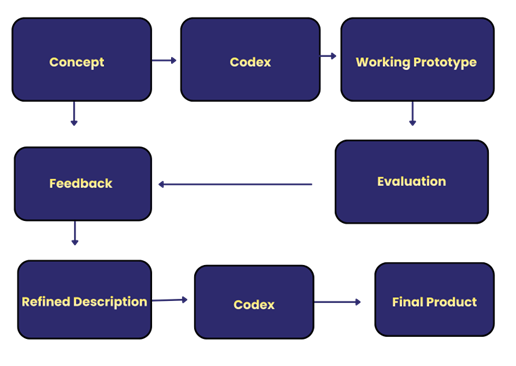
Furthermore, Codex enables rapid prototyping that would have been impractical before. When exploring new features or testing different approaches, developers can generate multiple implementations quickly. This accelerated experimentation leads to better solutions because teams can evaluate more options within the same timeframe.
For example, when a client requests a new feature, our team can now generate three different architectural approaches in the time it previously took to manually code one. This capability allows us to present clients with options backed by actual working prototypes, not just theoretical descriptions.
Reduced Context Switching
Another significant productivity gain comes from reduced context switching. Developers often need to reference documentation, search for syntax examples, or recall API methods. With Codex, this information is integrated directly into the coding environment. Instead of breaking focus to search Stack Overflow or documentation sites, developers can maintain their flow state while the AI code generator provides the necessary information.
The Human-AI Collaboration Model: Why Developers Remain Essential
Despite Codex’s impressive capabilities, the notion that it could replace human developers fundamentally misunderstands both the technology and the nature of software development. In reality, Codex operates most effectively as a collaborative tool that augments human intelligence rather than replacing it.
Strategic Thinking and Architecture
While the AI code generator excels at implementing specific functions or components, it lacks the holistic understanding necessary for system architecture. Developers must still make crucial decisions about overall application structure, technology stack selection, scalability considerations, and security architecture.
Moreover, Codex cannot understand business requirements, client needs, or project constraints in the nuanced way that human developers can. Our team members still conduct requirements gathering, translate business goals into technical specifications, and make strategic trade-offs between competing priorities.
Quality Assurance and Code Review
Additionally, AI-generated code requires human oversight. While Codex produces syntactically correct code most of the time, it doesn’t always generate the most efficient solution or follow project-specific coding standards. Our developers serve as editors and quality gatekeepers, reviewing and refining AI-generated code to ensure it meets our rigorous standards.
This review process is faster than writing code from scratch but maintains the quality and consistency our clients expect. The AI code generator provides a strong first draft, and human expertise elevates it to production-ready code.
Creative Problem-Solving
Perhaps most importantly, Codex cannot replicate the creative problem-solving that defines exceptional software development. When facing novel challenges or designing innovative solutions, human creativity remains irreplaceable. The AI assists by handling routine implementation details, freeing developers to focus their creative energy on breakthrough solutions.
Codex in Context: Comparing AI Code Generation Tools
To fully appreciate what Codex brings to our development process, it’s worth briefly comparing it to other popular AI tools that developers might encounter.
GitHub Copilot
GitHub Copilot is actually powered by Codex, making it one of the most direct applications of this technology. Copilot integrates seamlessly into code editors like Visual Studio Code, providing real-time code suggestions as developers type. It’s essentially Codex packaged into an IDE plugin format, making the AI code generator’s capabilities accessible within the natural development workflow.
ChatGPT and General Language Models
While ChatGPT can generate code, it’s trained primarily on general text rather than specialized code repositories. Codex, in contrast, was specifically trained on vast amounts of source code, making it more accurate for programming tasks. Think of ChatGPT as a generalist that can help with code, while Codex is a specialist built explicitly for software development.
Nevertheless, both tools have value in a developer’s toolkit. ChatGPT excels at explaining concepts or drafting documentation, while Codex produces more reliable, production-ready code.
Other Specialized Code Generation Tools
Various other AI-powered development tools have emerged, each with specific focuses. Some specialize in test generation, others in documentation, and still others in code refactoring. What distinguishes Codex is its versatility it can handle multiple aspects of the development lifecycle within a single system.
How CDT Leverages Codex for Superior Client Outcomes
At CDT, we’ve strategically integrated Codex into our development methodology to deliver exceptional value to our clients. This adoption hasn’t been about replacing our talented development team; rather, it’s about empowering them to deliver more sophisticated solutions in shorter timeframes.
● Faster Time-to-Market for Client Projects
By leveraging the AI code generator for routine implementations, our team completes projects more quickly without sacrificing quality. This acceleration benefits clients who need to launch products ahead of competitors or respond rapidly to market opportunities. The time saved on implementation allows for more extensive testing and refinement ultimately producing better software.
● Enhanced Innovation Capacity
With Codex handling routine coding tasks, our developers invest more time in innovation and problem-solving. They explore cutting-edge technologies, experiment with novel approaches, and design creative solutions to complex challenges. This increased focus on innovation translates directly into competitive advantages for our clients.
● Scalability and Flexibility
Furthermore, Codex enables our team to scale more effectively. When project demands spike or tight deadlines loom, the AI code generator helps us maintain velocity without compromising standards. We can take on more ambitious projects and deliver comprehensive solutions that might have previously required larger teams or longer timelines.
● Knowledge Democratization
The AI code generator also serves as a knowledge-sharing tool within our organization. Junior developers can learn from the code patterns Codex suggests, while senior developers can quickly explore unfamiliar
technologies or frameworks. This knowledge democratization strengthens our entire team and accelerates professional development.
The Future of Development: Embracing AI as an Enabler
Looking ahead, the relationship between developers and AI code generators like Codex will only deepen. However, this evolution points toward enhancement rather than replacement. As these tools become more sophisticated, they’ll handle increasingly complex tasks but the need for human judgment, creativity, and strategic thinking will remain constant.
The most successful development teams will be those that embrace this technology thoughtfully, understanding both its capabilities and limitations. At CDT, we’re committed to staying at the forefront of this evolution, ensuring our clients benefit from the latest technological advances while maintaining the human expertise that makes truly exceptional software possible.
Conclusion: Amplification, Not Replacement
Codex represents a paradigm shift in software development not because it replaces developers, but because it amplifies their capabilities. This AI code generator handles the repetitive, time-consuming aspects of coding, freeing human developers to focus on what they do best: solving complex problems, making strategic decisions, and creating innovative solutions.
At CDT, our experience with Codex has proven that AI and human expertise form a powerful partnership. Our developers are more productive, more creative, and more valuable than ever before. For our clients, this translates into faster delivery, higher quality, and more innovative solutions.
The question isn’t whether AI will replace developers it won’t. The real question is how quickly development teams will adopt these tools to remain competitive in an evolving industry. At CDT, we’re already leading that charge, combining cutting-edge AI technology with world-class human talent to deliver exceptional results for every client.
Ready to experience the benefits of AI-enhanced development for your next project? Contact CDT today to learn how our Codex-empowered team can deliver superior software solutions for your business.